Practice as a Flower Garland
At our last Satsanga, we sat with a simple image: the practice as a flower garland.
Imagine a garland being strung by hand in the early morning. Petals still cool with dew, soft as breath against the fingertips. A scent that rises before the flower is even seen: jasmine, marigold, rose. One flower, then the next, each threaded with care. Each one is complete in itself, a small, quiet offering. And each is here for only a short while.
Our postures are like this. Each one opens, offers its fragrance, and shows us what it has to show. Then, just as gently, we let it go and move into the next. With every transition, the body reorganizes, and so does the mind.
No posture is ever the same twice. What opened easily yesterday feels tight today. The balance that came without effort last week now wavers. The flower is different every morning, and so are we.
This is why presence matters. A flower cannot be held too tightly without bruising its petals. If we grip, trying to keep the beauty alive a moment longer, or rush ahead to what comes next, we miss its sweetness altogether. The invitation is to stay close, attentive and soft, and to let each posture be exactly what it is, for as long as it is. Then to release it with gratitude. The tradition pairs practice, abhyasa, with non-attachment, vairagya. We show up fully, and we hold lightly.
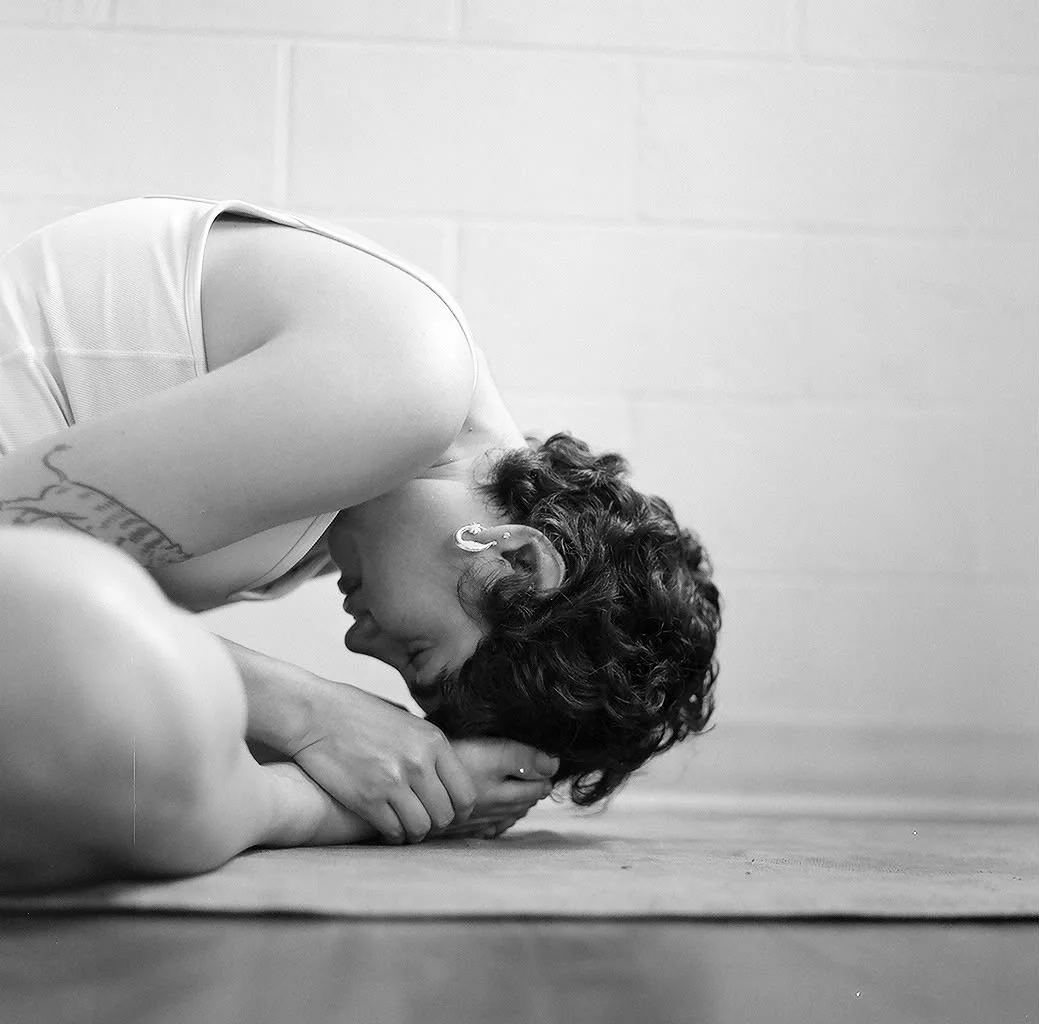
Baddhakonasana, turning inwards as we transition into fall.
The thread
In Sanskrit, sutra means thread, the same word given to the teachings, strung line by line into a whole. In our practice, the breath is that thread. Unbroken, it runs through every posture and holds the garland together. And like any garland, the whole becomes more than its flowers: the sequence teaches what no single posture can show us on its own. When the breath is steady, each flower rests in its place. When we lose it, the flowers begin to scatter.
The container
The sequence gives us a container: the same postures, in the same order, day after day. From the outside it can look like repetition. From the inside it becomes something else, a quiet, clear space where the subtle can finally be noticed. Because the form stays the same, we begin to see what changes.
The layers
Over time, the finer layers of practice reveal themselves. Bandha, the gentle inner lift that gives the thread its tension. Drishti, the resting place of the gaze that gathers the mind. These cannot be rushed. They open when breath and posture are smooth and steady, each in its own time. Nothing arrives all at once, and that is the gift. The practice unfolds over a lifetime.
The spiral
So the practice is not a line with a beginning and an end. It is a circle, or perhaps a spiral. We return to the same postures again and again, meeting them each time from a slightly different place. Each practice we let go of, and still something stays: layers of experience that settle into us and make us more resourceful, on the mat and off.
The seeds
As the bloom of summer gives way to fall, the flowers soften, their petals loosen, and they return to the earth. What remains is the seed.
This is karma, quietly at work. Every breath taken with attention, every posture met with intention, is a seed sown. The seeds scatter, settle into the dark soil, and wait. In their own time, they grow into what we have planted.
Proper attention, proper intention. One breath, one flower, one morning at a time.
Come practice.